
Atheist is Cool
Why Atheist is best as a puzzle.


“Demons aren’t of fire and brimstone, but of suit and tie, preaching terrible lies that pit man against man, good wills cast into sin. Even if it costs me my one precious light, I’ll expose this elaborate lie for the fable it is.”
“The Storyteller can break the game rules, and if executed, good wins, even if you are dead. [No evil characters]“
The Atheist knows that all players are good and there is no such thing as Demons.
Introduction
The Atheist is a character based on a common thought experiment in Werewolf moderation - what if there are no werewolves? Would the players figure that out or would they accuse each other until nothing is left?
Atheist takes this prank concept and gamifies it. Instead of just the game moderator being in on the joke, one other player, a Townsfolk, knows too. It is the job of the Storyteller to run a game as if it is just a normal game with an evil team. The Atheist must convince the group that all of them are good, and that the tragic murder that struck Ravenswood Bluff to its core was nothing more than an elaborate trick. The problem is that the good team will be hesitant to believe them, since if the Storyteller is executed with no Atheist in play, evil wins. In addition, the evil team knows the Atheist is out of play, so a Minion can easily pick up the bluff without ever needing to discuss anything with their Demon.
The Atheist is then trying to find who – and as what -- the Storyteller is framing as what, and kill them to help prove their world true. If all suspected Demons are dead, how could they be real?
What can result from this concept is a very intense game where, through bickering and distrust, good struggles to execute into the best Demon candidates. Then, on the final day, just you as the Storyteller and 1 of the players remain as the possible mastermind behind the killings in Ravenswood Bluff. It becomes a test of faith. Do they believe that evil exists amongst them, or do they believe in each other and execute you instead? Even if town can’t fully explain everything that has happened, even with a few players still actively disagreeing that it is an Atheist game, the trust town shares is enough to execute you narrowly… Good wins, and everyone cheers, relieved after the most intense final day they’ve had in months.
This might sound like a pipe dream, as if an Atheist game could ever be like that. Aren’t there supposed to be 5 Lunatics? Well, this is a description of a real game I have storytold. Town left the Atheist alone under threat of a Boomdandy explosion, and on the final day, I had killed the Demon frame, indicating a starpass to one of the living players. The town eventually managed to work out that most worlds could not work, just as the game was coming to a close. There were still viable mechanical worlds, but all felt socially unviable. With a correct understanding of the character, intense final days of an Atheist game are not just possible – they become commonplace.
With such stellar highlights, it’s especially unfortunate that the Atheist is one of the most misunderstood characters. Typically seen as a silly character where constant shenanigans occur, storytellers and players often assume that nothing needs to make sense. As I found when polling 75 players, atheist games are often viewed as pointless rather than “proper” clocktower. Instead, Atheist games become that silly prank we first discussed, where the Storyteller eventually reveals all with blatant rule breaks, everyone has a good laugh, and the group moves on. Whilst with the right group this can be a great deal of fun, I will argue here that this is both against the intent of the character and by far the inferior way of running it.
I am not alone in this push. Recently, Emma released an essay on the importance of strategy within an Atheist game. Edd has talked about how, in the coming months, he wishes to run more popular Atheist scripts with Puzzle Atheist, as it is a side of the character rarely shown off on streams. The community as a whole is shifting towards this perspective, but the dominant opinion remains that Atheist games tend to not be as worthwhile as others.
The Atheist when run correctly (in my opinion) is logic and belief all in one package: the game result rides on town believing a single claim… What else could be more Clocktower? You don’t need to interject your own silliness and whimsy so overtly: you can do this with subtlety and with care, and you’ll find that it is your players who do the rest.
First, definitions!
Throughout this essay I’ll be using the following terms, two of which I’ve coined through extensive brainworms.
Puzzle Atheist - Atheist where it is immediately obvious to at most 1 player that there is no Demon in play. The game could be a real game of clocktower with an evil team, but something subtle breaks this. This break can be social or mechanical (and, in most games, is ideally a bit of both).
Shenanigans Atheist - Atheist where it is immediately obvious to at least 2 players that there is no Demon in play. The game has had mechanical impossibilities, overt hints, or just outright announced rule breaks.
Theist - Non-Atheist games. Demons are real!
It’s very difficult to articulate where we truly draw the line of “what is too silly”? These definitions broadly hold, but it is important to note that some Puzzle Atheist games will have more than 1 player know that is Atheist (there is one possible evil team, and the players in it know they are good), and some Shenanigans Atheist games will have a maximum of 1 player know it is Atheist definitively (8 damsel game). Therefore take these definitions as “this is broadly the expectation for these games” and not “every Puzzle Atheist game means no one else knows”
Atheist is Cool
Atheist games are not lesser, you just might not have agency.
A common sentiment in the community is that Atheist games are less meaningful than standard games of clocktower.
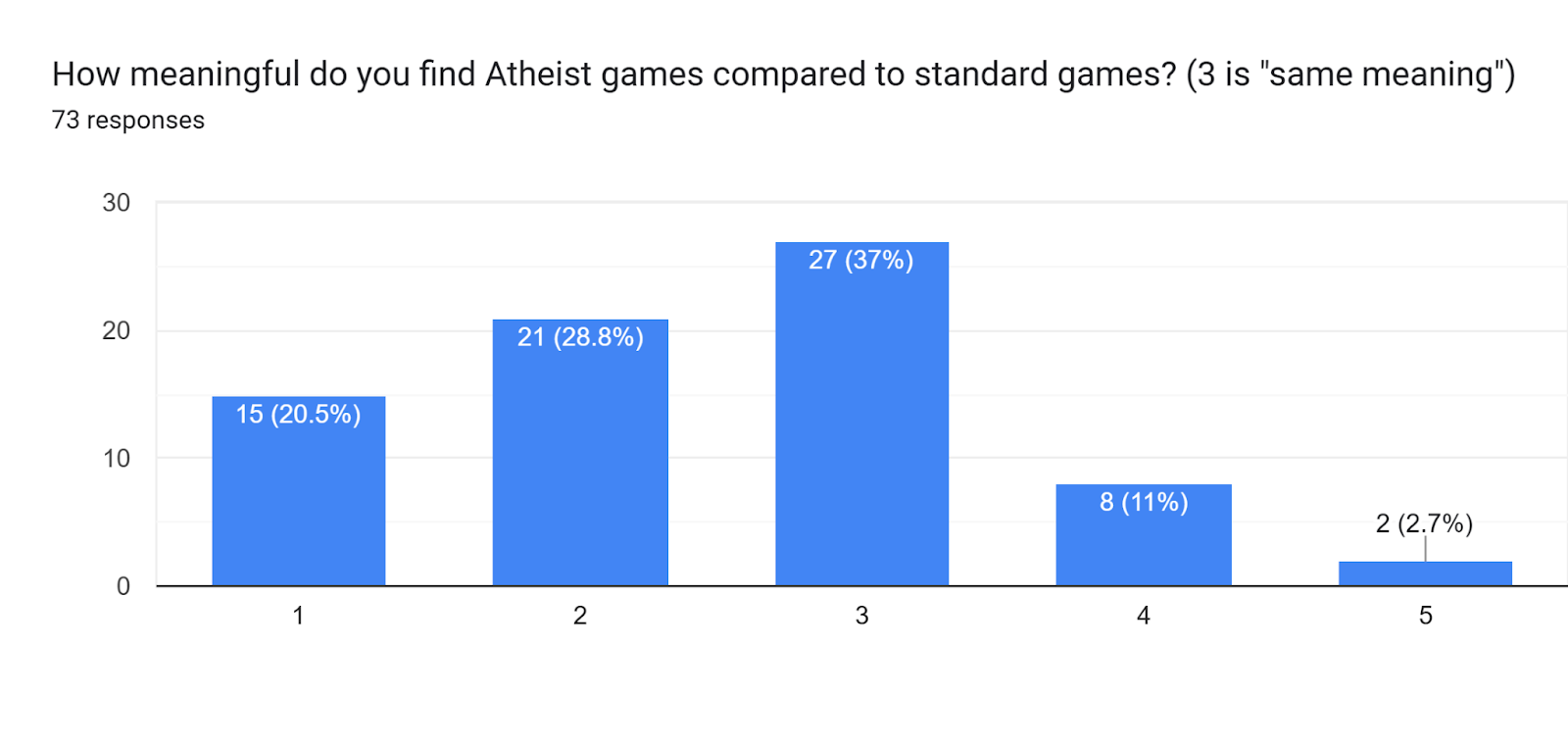
Above data is sourced from a survey I created. Link at the end to the results!
This sentiment can be derived from experiences with Shenanigans Atheist.
Most players in a game of Clocktower are attempting to win. Before going for any game ending decision with a chance to backfire like Atheist, most rational players will attempt to eliminate every Theist world first. In a Puzzle Atheist game, this is actively encouraged and players who do not engage with finding the Theist worlds will find themselves with a difficult final day. In Shenanigans Atheist, it will quickly become obvious it is an Atheist game but niche Theist worlds will be built regardless. Players will be very unlikely to choose to end the game early unless it’s especially egregious, so in a chance to maximise their odds of winning before executing the ST, they will build insane worlds that make very little sense whatsoever then work to close them.
If 3 players are claiming to have been chosen by the Cerenovus yesterday on a script with no Cerenovus town will execute all 3. And if they have an execution to spare, they’ll kill someone else. It often does not matter that the coordination to make this play is insane, or that the mechanical word doesn’t work, or that it’s socially unviable: good will always default to killing these players because it is the safest mechanical option, and guarantees victory no matter what, even if they believe these players. The good team has already won and is just doing busywork & filing the paperwork. This sucks.
Doing something mechanically impossible, or otherwise signalling Atheist overtly to a player, only creates more Atheists: players who know beyond a doubt that the game ends when the Storyteller is executed. If the Atheist itself is a policy execution, then creating more Atheists merely creates more policy executees. You invite people into the coalition of Atheists at your whim instead of theirs.
Beyond that, creating more Atheists removes the unique role the original Atheist had: that of your nemesis. The role of the Atheist is to invite people into the world where Good must execute you, so when you’re doing their work for them, what’s the point of the Atheist in the bag at all? If it becomes self-evident it is an Atheist game without their intervention, why is the Atheist even playing the game?
This is what contributes to a heavy sense of pointlessness in an Atheist game, moreso the more the Storyteller chooses to become obvious late into the game. If this happens, the Atheist literally didn’t need to do anything but claim the character, so why would you bother? Why did anyone bother in this game? They just spent an hour playing a game that was destined to be a good victory, so who cares that they won? Maybe it was a bit silly, but the opportunity cost of playing an “actual” game will forever be felt by players in Atheist games that are run like this.
After experiencing games in this vein, many Atheist players just do not believe any actions they take during the game will impact its outcome. The truth shall become self-evident, and good will always win even if they never claim to be the Atheist. If this is how your players feel, you have made a mistake in running Atheist.
An Atheist game’s ultimate goal, like that of any other Clocktower game, is to make the final decision of the game as intense and as interesting as possible. If you can accomplish a game where only a slim majority of players vote for your execution, players will speak of it for months to come. I would know. My players regularly mention “that really good Atheist game” and other “then everyone clapped but its real you gotta believe me” type stuff, and this was enough of an ego boost that I wrote [how many ever words this shit has] words about this character as if I know it well.
Atheist games CAN be intense to play. Atheist games are still social deduction games if the Storyteller allows it: figuring out that no one is lying and you are all good, is not taking away from the world’s greatest bluffing game but adding a whole new axis to the puzzle.
The Atheist is a puzzle
Atheist, like any other character in clocktower, exists to be part of a puzzle. Like a Demon, the Atheist exists as the solution to the puzzle, rather than one of the pieces used to solve it. It is ultimately a puzzle character.
But what do I mean when I say that Atheist is a puzzle character? In what way does this character facilitate a puzzle? If the character is all about the rules being broken, why must there be any rhyme or reason to the actions taken by the storyteller to run this character at all? Isn’t the point to break the rules?
First, let’s establish what Atheist’s intent is, by looking at this excerpt from the almanac.
The Atheist is a complex character, and is recommended for experienced Storytellers. In addition to rules knowledge, it requires you to have a good sense of fun and fairness. It is your job to create a fun game for all players, so only break the game rules to give false information (as much or as little as you want) or simulate the actions of evil characters that could be in play, but aren’t. If you can convince the players that there is no Atheist in play, or at least get them discussing the possibility, you’ve done well.
As you can see, the Almanac recommends a serious take on the Atheist. The goal presented to you (besides the regular priorities of fun) is to try and convince the players that no Atheist is in play.
This means that a storyteller running an Atheist game should be doing in such a way where the ability to tell if it is one, or an evil player bluffing, is extremely difficult. The aim is that answering this requires an entire game of compiled info, worldbuilding, and socials to fully tackle. Convincing the good team that there is no Atheist in play requires you to carefully plant bad info into the game, and choose good players to frame. You break rules to simulate a real game.
But the way that the Atheist is most often run tends to be on the sillier side compared to the recommendations. Weird character changes, strange information that can only ever be false, strange storyteller consults, a baker’s dozen Lunatics. Atheist is often wielded as a “silly fun” character by storytellers, aiming to make the game more fun by using the ability to break the rules to do so with imagination unbound.
To explain why this is wrong, we should discuss other nonconformist characters and why these characters breaking the game in obvious ways can be fun.
The Wizard can make extremely strange behaviours occur within any given gamestate, causing untold chaos and confusion. This can be very fun given the correct Storyteller, and this is a minion ability designed to sow confusion and muddy the solve.
The Amnesiac can have any ability of the storyteller’s design. This is extremely fun for the Storyteller, and if they can execute it well, very fun for the player too. The Amnesiac itself is its own unique puzzle, that at the same time, can lend itself to more absurdist elements in an appropriate script environment.
It might then feel appropriate to lump Atheist into this duo by viewing it as an Amnesiac of sorts. The Amnesiac is intended to have puzzle-type abilities, but the character on the right script can do other things. As a nonconformist character, it can fit any script by mere flexibility. The Atheist must be the same, surely. This would be incorrect. Unlike the Amnesiac or Wizard, the Atheist should not be able to do anything, even if paired with other nonconformists.
The Atheist is a puzzlebox grander than the Amnesiac or Wizard. Absurdist behaviours with an Amnesiac tend to result in their ability being solved immediately, but that’s ok: it is merely the Amnesiac’s own puzzle and the Demon still must be found. If the Wizard clue is solved and the wish deciphered, you merely understand a fraction of the wider picture, and the Demon still lurks in the dark.
If the Atheist does absurdist behaviours however, the puzzle of the grander game itself has been solved. If a behaviour is impossible, then it must be Atheist from any player seat that observed it. The game is now over for these players, and they are simply waiting for everyone else to catch up. Running these other characters may have taught you that silly absurdist stuff going on is really fun, and it is! But Atheist is not the character for this kind of game. As long as you focus on the fact that Atheist is the puzzle rather than a single piece like these other characters, the amount of care taken to run this character properly can be appreciated.
This in addition shows the power of an Atheist bluff. Forcing every good player to engage in world building without this axiom means that the game’s complexity expands tenfold, making even very experienced good teams struggle to properly tackle the game. Whilst bluffing Atheist as an evil player means you get built as evil quite often, good teams would find your Demon faster if they didn’t need to consider themselves, and fall into the wrong rabbit holes. If there is a reason you can be good as the Atheist claim, with no Atheist ability in play, it expands even more. Even if no one believes you are the Atheist, you have done damage to players’ abilities to solve the game: because you still must be considered.
When the Atheist is run in a less absurdist fashion, you quickly notice why this character is so interesting to add into a puzzle from the player perspective. In most games of clocktower, you can assume you are definitely good and that your information is important in the wider puzzle: you will rarely ever build yourself as evil. In an Atheist game, you are challenged to consider even yourself in possible evil teams – good players with sober information might learn that you are evil. Your own “alignment” is under question, and in order for your team to have the highest chances of winning, you might need to solve for yourself being the Demon. The puzzle must be considered not from a player perspective, but instead from a birds eye view. There is now a third explanation beyond drunkenness & poisoning, or evil players, on why information is suggesting you are evil: making the game far more convoluted to understand.
Shenanigans Atheist is unbluffable for evil teams
A core component of Atheist is the idea that it could always just be an evil player bluffing the character. Identifying that the Atheist is out of play is trivial for an evil player, but bluffing Atheist from an evil team perspective is actually an extremely nuanced decision that requires evil to buy into a huge gamble. They need to be ok with losing an evil player (in most cases) to sell a world that might still end up with their Demon being executed in the quest to prove Atheist worlds true. Bluffing Atheist requires the entire evil team to restrict their play space and read socially good as a unit. To look like you’re all good players attempting to put the puzzle pieces together, none of the evil team can falter and out evil.
You lose an evil player early, you can’t do socially evil plays, you can’t be a distraction as a minion as it can backfire into the Atheist worlds closing, and you all need to be actively helping good solve to actually look like an Atheist attempting to find the frame. It’s a tough bluff, but in exchange, you gain two powerful tools to exploit. When an Atheist claim is in the game, the possibility space of the puzzle expands massively, requiring players to consider a lot more, including themselves being a frame in Atheist worlds. If you sell it just right, the good team also loses the final day to execute into Demon candidates and executes the Storyteller.
Storytellers should very much try their best to facilitate an environment where this bluff is possible. It’s a high risk, high reward bluff that truly tests a player on socials and mechanics both.
Shenanigans Atheist makes this delicate yet powerful bluff practically impossible to handle with subtlety. Ideally, with a good Atheist bluff, your evil team can distance themselves from you and Atheist worlds a bit in order to look like they are good players that distrust the Atheist claim. However, in Shenanigans Atheist, the Atheist bluff requires much more buy-in. If a regular thing in your Atheist games is the farmer being killed each night, evil must work to do this. If mechanical impossibilities are regular, such as character changes, then evil must bluff this.
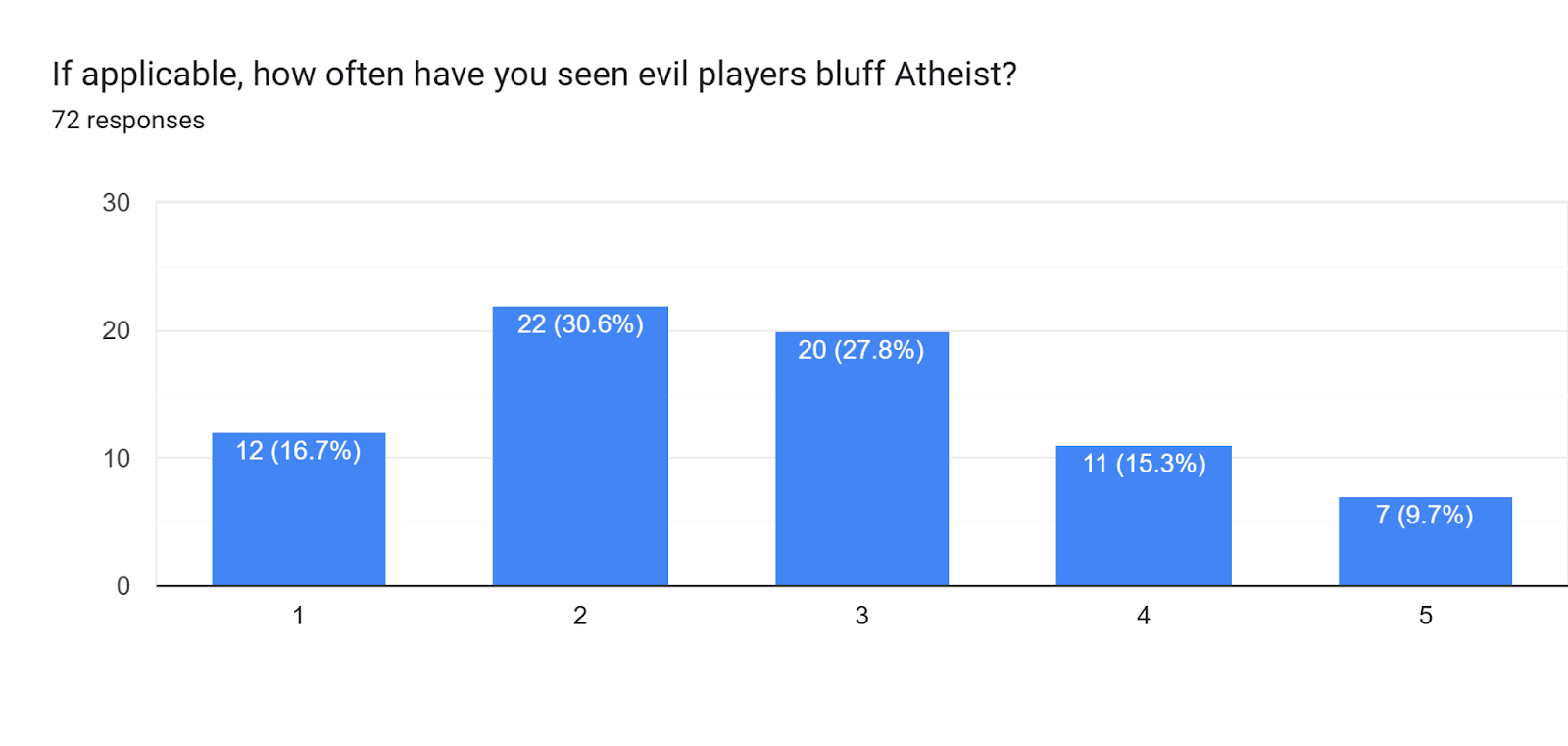
Shenanigans Atheist requires not just 1 Atheist bluff from evil, but several. Recall how earlier I regarded mechanical impossibilities as something that just creates more Atheists. If this is true for the good team, it is true for an evil team bluffing Atheist. They must all bluff Atheist in order to sell it. This puts them at risk at policy execution, and makes Atheist even more of a buy in for the evil team. Despite the risk being ever higher - requiring the entire evil team to hard sell Atheist in order for it to work at all - the reward remains the same if not lessened: the final day is not spent on the Demon candidates, but good knows exactly which players are evil in Theist worlds. Should the evil team distance themselves from the Atheist bluff, the minion is left out to dry in an ineffective play.
Remember that the Storyteller’s aim of an Atheist game is to convince the good team that no Atheist is in play. This means that the game should have near perfect parity with an evil player bluffing, with only subtle breadcrumbs and social reads to distinguish the two.
You should trust your players more.
One reason that Shenanigans Atheist is so popular is because, in Atheist games, Good benefits from clues. If you frame an evil team perfectly, mechanical players will tend to find discovering Atheist worlds very challenging unless town has killed into those worlds. Usually a good Atheist game’s central challenge is discovering the fake evil team before the final day, and killing them. While a few extra clues are helpful, someone claiming Atheist at all closes many worlds already! Giving extra clues is something you should do with great care and subtlety. Ideally, clues are most likely to be discovered as unworkable on the final day, if discovered at all.
However, Storytellers signal an Atheist game far too much, as if worried that their players will not be able to figure it out.
Instead of undermining your own game, believe in your players. Trust your Atheists to do the job you assigned them: to convince good that you are a fraud. It is not your job to convince players there is an Atheist in play, it is the Atheist’s. Allow the Atheist to have a puzzle to dwell over and solve, and let them share their struggle with their allies. In a real game of Clocktower, viable social & mechanical teams are buildable and workable: if the Atheist can find the one you are falsely trying to sell as real, they can kill into those worlds and prove it is an Atheist game.
Unlike other games of Clocktower, every player in an Atheist game is good! Since all players are secretly working together, you will find that voting patterns, trust circles, and willingness to accept specific worlds softly outs an Atheist game socially. Socials are not the only tool a good team in an Atheist game will use, and some players will prefer mechanics to socials in any game, but social reads are one of town’s most powerful assets in a Puzzle Atheist game. This means that your players, if socially driven, will solve for Atheist even without mechanical information, and the players you are trying to frame might even find that they must be mechanically evil in most worlds!
No, livestreamed games are not examples of good Atheist games.
Livestreamed Atheist games are some of the most crazy entertaining experiences you’ll watch. These games are often played by highly experienced veterans, capable of truly insane solving and bluffing, and also have had years of experience playing on stream to keep it fun and entertaining. Throw in an Atheist, and watch them go! Anything could happen, and these groups can keep it fun and engaging, even if you’re doing things that aren’t necessarily the best storytelling wise.
On streams, we’ve had a few examples of insane Atheist games. A good example of this is the one where Ben B runs an Atheist game where the 3 lunatics all learn another in the chain, and that they only have 1 minion because of some simulated Amnesiac ability. This game is amazing to watch! I truly recommend it, because despite all odds, for just a little bit of the game, the Lunatics all believe that they are genuinely evil together.
However, this game is definitionally a Shenanigans Atheist game. If it wasn’t for a masterful pivot with the Amnesiac “ability”, the game was hardsolved Atheist from many players’ perspectives. This game was very unlikely to be a serious attempt at showing Atheist off on stream, and was rather meant to be an entertaining game that happened to work for just a little bit.
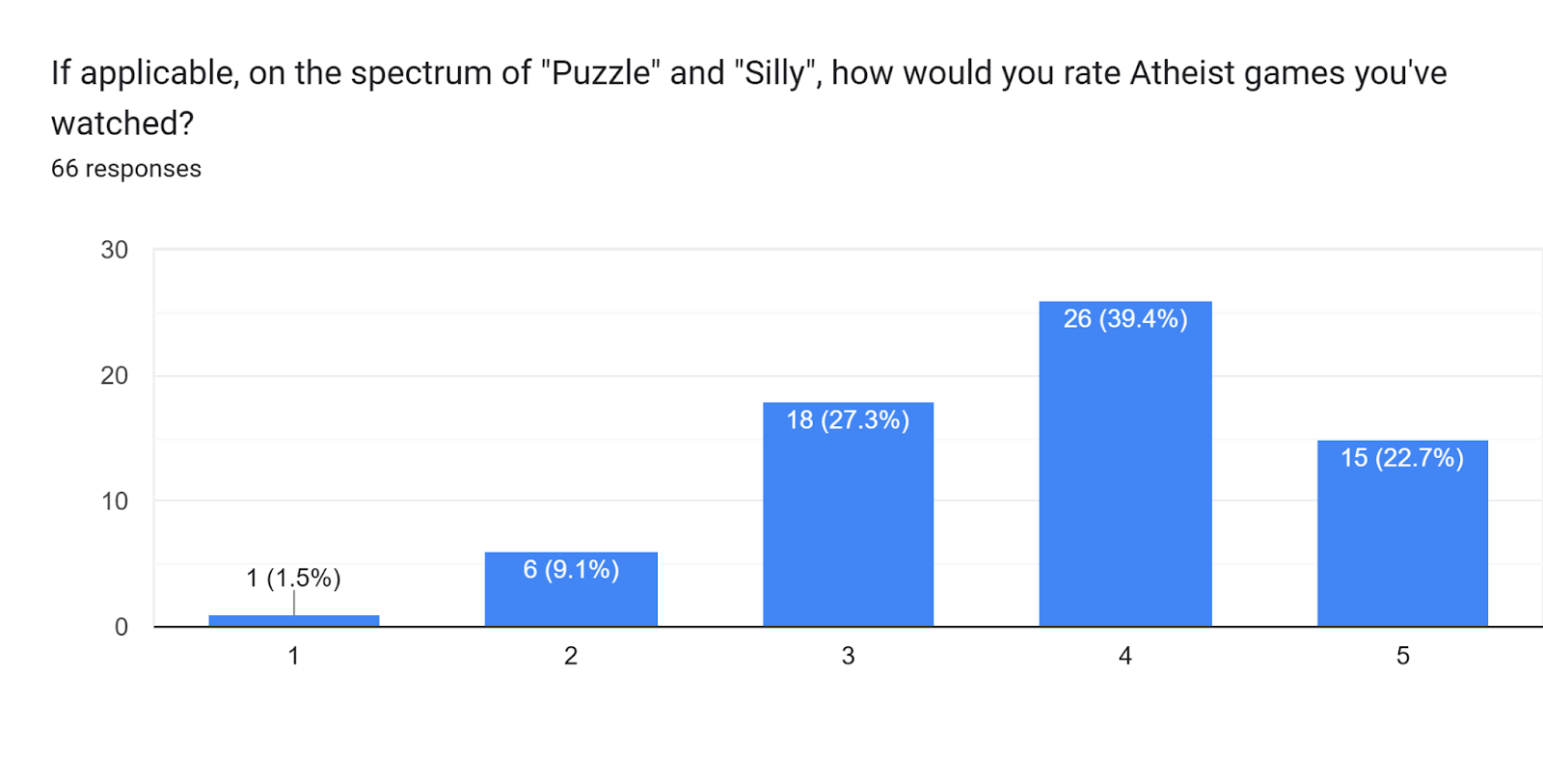
These games are not examples of how you should run Atheist. In the example game above, if it wasn’t for the on script Legion, good would have won practically immediately due to the amount of insane nonsense. Legion gives great cover to Shenanigans Atheist games, but running it in this way still results in the same frustrating points laid out above. In the framed Legion world, many of the good players being framed are just in this weird position where they are waiting for everyone else to figure it out, and don’t really have much to do. These games ARE entertaining, but they are primarily fun because you are watching the Storyteller point of view, and not actually playing, and the players are people who may not even care about if the Atheist game feels real or not, they’re just having fun. Some might care, but it’s a stream and having a silly time is partially part of the experience. In proper games of clocktower, players are hoping to try and actually do some social deduction. They have no audience, except you, so replicating livestreamed games only serves to alienate the players and be fun just for you, the Storyteller.
In recent good news for Puzzle Atheist, Edd has recently announced on a Sunday stream that in the coming months he is hoping to show off Puzzle Atheist! Yippee!!!! His first game of this was on my script, Star’s Edge!
No, Demon Atheist does not fix Shenanigans Atheist’s problems.
The Demon Atheist is a bootlegger rule that changes the Atheist from a Townsfolk to a Demon. In a Demon Atheist game, no one draws the Atheist token, and the Storyteller has the Atheist ability instead. Essentially, it is an Atheist game without any player needing to claim they are the Atheist.
The Demon Atheist is a fun idea for a streamed game of Blood on the Clocktower, showcasing the Shenanigans variant of the character without someone actually pulling the token. Pulling the Atheist token can be a little feelsbad in a Shenanigans Atheist environment, as everyone else is learning it’s an Atheist game and you’re not really doing much. So if the Atheist was a Demon type instead, and no one pulls the token, then you can be a little more silly without anyone’s role in the game being undermined.
Firstly, this takes away one of the major hints that it is an Atheist game: the Atheist claim. If no one is claiming Atheist, then the biggest clue is gone! The Storyteller is now required to give more heavy handed clues in order to help the good team figure it out! Which creates… more Atheists. So we’re back at where we started, just sillier.
Secondly, this requires evil to bluff specifically weird nonsense in order to bluff “Atheist”. They need to bluff the weirder nonsense you would be doing to indicate it is an Atheist game… so become Atheists. And we’re once again back where we started, just sillier.
Demon Atheist is a fun idea, but in order for it to actually be fun, the game will often require very broken puzzles that truly go nowhere (very hard to do with no Atheist token on the grim), or silly wackiness to give someone a virtual Atheist token.
Ok wise guy, if you’re so smart, why don’t YOU take a crack at it.
Of course, after all of this “you are running this character wrong” yapping, it’s only fair that I actually explain how I run the character and give guidance instead of complaining. The Atheist is a very difficult to run character, and whilst I do give off the air of someone who believes they have all the answers, I would not want to give that impression.
I know I run fun Atheist games, so this is absurd confidence in the style of Puzzle Atheist because I know it works and that Shenanigans Atheist doesn’t. But when it comes to the actual implementation of Puzzle Atheist, I am still learning and still working out finer details and points.
Ultimately, the Atheist is the ultimate character for self expression. How you play and run Clocktower meld, allowing your personality and voice to sing through the decisions you make. That means, just like our own creativity, personalities, and philosophies, the Atheist is ever changing.
I’d recommend finding your own voice, and whilst I recommend some practices to you, it’s best that you discover what is best for you.
Let’s get into it!
You’re the Big Bad Evil Guy
If you’ve ever run a combat encounter of Dungeons & Dragons, a very common balancing act is challenging your players without killing them. In a combat encounter, you want the players to feel like there’s a possibility that they die… or even better, be convinced that they are going to, but win despite that hardship.
If there is sincerely no chance of anything going wrong in a combat encounter, then the entire battle feels pointless. Instead of a fight being a way to ratchet up the stakes or deliver a climatic crescendo to an arc, it becomes the moment tension deflates and players start thinking about the next part of the campaign rather than being engaged in the battle.
In an Atheist game, a similar principle holds. You roleplay the antagonist, the big bad that the good team are hunting. The Atheist already knows that no such things as Demons exist, and that you are fabricating the story upon which the game is set within. Narratively, the character you play must work to discredit them, in order to prevent themselves from being executed.
It is powerful in DnD to try and think through the monsters’ strategies available to them due to their unique abilities, as getting into the shoes of these creatures can often create extremely intense and interesting DnD combat encounters. This idea can be similarly applied to an Atheist game: pretending to be an evil player that is genuinely trying to get away with it is a great heuristic for an Atheist game.
The important thing is to not actually try to win. An important thing of running D&D encounters, is that despite the insults and swords thrown the players way… You want them to win! Even if those monsters are using their abilities to the best they can, you have still ultimately designed the encounter to be overcome by the players. You could in theory throw 300 dragons at your level 2 adventurers and revel in how easy it was to kill them: but that’s stupid and we all know it. What is interesting is when you throw a single dragon at them, one which is injured and thus has exposed weaknesses, so the adventurers could possibly win: if they applied themselves correctly.
Choose your evil team
One of the best habits for running a Puzzle Atheist game is choosing an evil team to frame. This has plenty of advantages.
Most information you give will be targeting these players, providing focus to the information you give.
Since you are actively attempting to frame these players, a subtle thing about your storytelling - balancing the game - is not happening from the perspective of “evil”. You want good to think there’s an evil team, and that means you are pushing an agenda that would normally be very good sided. Clever players may pick up on this, and it’s an interesting but not silver bullet tier clue to the game’s nature.
The social players will have very something to add to mechanical worlds: whilst the mechanical worlds work, the social players struggle to believe that this is a genuine evil team working together. A common occurrence in framed Atheist teams is that they actively bicker and fight, as they’ll be acting on other player’s information sincerely, which is unusual for evil players to do to each other.
When choosing an evil team, consider your Atheist heavily. If they are a social player, then they will already have an advantage in convincing good it is an Atheist game, so pair them with players who might have trouble reading good, or pin them as good but not the Atheist (e.g, Drunk or Cerenovus mad). If they are someone who is mechanically inclined, you can pair them with others who are proficient in social play, and you should frame them as evil more often than as the Drunk or mad. A framed Atheist team having a mix is ideal, as the mechanical solvers can find the world you’re faking, whilst the social players can help good players believe the rest of their “team”.
You should be thinking about decisions these players would be making as evil players. Would they bluff this? Would they choose that player? Would the Demon really kill the Ravenkeeper despite them knowing who it is?
In general, a focused evil team frame is a great tool for an Atheist game. It gives the game direction and in my experience feels like the most consistently engaging form of puzzle. The other method, giving arbitrary information that points nowhere and seeing where good finds itself, is harder to run well and often converges on “this is just Atheist” earlier than this heuristic. That being said, that can still be fun and is still a good way to run the character.
Break the Puzzle
Next is to break the puzzle. You’ve already left a clue for your social players - that everyone is on the good team - so it’s time to clue in our mechanical players too.
Generally, you want to take 1 element of the puzzle and break it such that the framed world becomes mechanically fringe if the game is correctly solved. That is to say, the information should point towards one specific team, but there are 1 or 2 things that just don’t quite make sense in the narrative built by you.
Here are some examples!
Make a player register as an extra minion in quieter minion suites. Too many minions or evil players will be odd: be sure to only do this if the bag has only a bit of direct evil/character finders!
Give Savant info that works in the world you’re framing - but only on odd days
Give the General, High Priestess and Fortune Teller legit info. The FT only has their red herring to find, the General and High Priestess learns your genuine opinion.
Snake Charmer. As you should never really convince a Snake Charmer they have swapped with a Demon, the Snake Charmer can break many worlds you intend to frame: especially if they end up choosing the Demon frame itself.
If your Demon frame dies, pivot to a new evil team. Your Demon frame is VERY likely to die before final 3 because they have no team protecting them, which lets a pivot be a great hint! If you can’t find an evil team that works anymore, your good team has already won and merely needs to discover it!
As mentioned earlier, thinking about your frames and how they behave can help sell Theist worlds… and ignoring it can be a great social hint when they inevitably get worldbuilt as evil!
Encourage Evil to bluff Atheist
If evil never bluffs Atheist, your group will slowly always believe that the Atheist claim must be good. For Atheist games to have the weight as has been previously mentioned, a group must be prepared for both Puzzle Atheist and also be willing to bluff the character.
This can be simply having conversations with your players about the character, including it in bluffs to remind players of the option (especially Snitch bluffs), and just in general running Puzzle Atheist consistently until players wisen up to the strategy themselves.
Is Good in Trouble?
If good is quite far from Atheist worlds, it can be tempting to give them a more overt hint, such as silly Savant info, mischievous day start announcements, etc. However, it’s important to note that Good can sometimes look like they are losing and aren’t building Atheist: but they actually are building Atheist! Some experienced Atheist players will not bother positing “in an Atheist world…” or “in a Theist world…”, instead they presume that good knows what they mean “in these Theist/Atheist worlds, this player is evil/framed as evil” will be shortened to “this player is evil in these worlds”. That being said, still view this as a warning sign and get ready to think up some measures to balance the game.
Think about how many Demon candidates are left! If there are fewer executions than there are Demon candidates left, it will be a tough position for the good team. Ideally, the final day is a decision between you & 1 of the players. It is still fair to have an “evil sided” final day with it being between you & 2 players, but you want to aim for the feeling of a tense 50/50 (where you’ll still most likely be executed) to have that exciting final day. Therefore, you can broadly judge that “evil is winning” if the number of believed demon candidates exceeds the number of executions by 2 once you hit the midgame.
If evil is winning, rarely do hints. Instead, simulate a Demon making a mistake: kill a Demon candidate in the night. This is more subtle than a hint, and is entirely still possible in a real game where the Demon is making mistakes due to having incomplete knowledge or trying to go for a play.
Even if good is massively losing, respect their agency and do not panic hint it is an Atheist game. Even if the Atheist is “outed evil”, hold back the temptation to nullify the game with too many hints. Kill Demon candidates, keep thinking about how to bust false worlds, and stay calm.
Good is going to lose. What should I do?
If good loses whilst you are actively making “mistakes” from your Demonic persona, then you did all you could and at least your players can trust that you respected their agency. It can be tempting to unveil the tense game where players don’t trust each other as “surprise!!! You actually CAN trust each other,” as it can feel somewhat cathartic to the players who may have been having a stressful game. But you should not.
You might argue that the game being lost by all players will result in the game falling flat, and the excitement and tension deflating. You are likely, unfortunately, right to some degree. But if you choose to unveil the game at the last possible moment, this will happen anyway. If the solution always becomes obvious with time, then the puzzle is meaningless.
Let it ride out, believe in your players to come together, and if they do end up losing, remind your players of the moments that made the game fun: don’t focus on the fact they lost besides a few well timed jokes once the mood lightens. Keep the bits going, keep it fun, and change scripts to keep the mood fresh and exciting.
It’s a tough social situation and one that any storyteller would reasonably be anxious over. An amazing, intense game ending with everyone losing can seem very bitter: especially because on some level, it will feel like your fault, and that everyone’s eyes are upon you.
On some level, this will be unfortunately true. But that’s ok. An Atheist game is all about finding that perfect balance between the good team almost always winning and it feeling tense. Sometimes you’ll have games where you break too many things, and the game gets solved early and ends dully. By the mere nature of finding that balance, you will also sometimes have a game where you didn’t break the puzzle enough or kill enough Demon candidates when good is losing.
But sometimes, the Atheist claims to be a Goblin and you’re unable to save the game. From here, try to find silver linings to brighten the mood. Focus on the funny moments, interesting twists, or literally anything that you didn’t have a hand in that made the game fun and unique: that will help sweeten the moment. Try to turn it into something memorable.
Be ready to have a conversation with your group. They may have feedback or concerns, and they might be feeling a bit frustrated or annoyed. As long as you meet them where they are at, and explain what you tried to do to make the game fun for everyone, any reasonable person should understand your position, and you hopefully understand theirs too.
Remember, even if players give you flack, you are storytelling the most complicated character to run in all of Clocktower. Not only that, you are doing the version that risks this exact moment occurring, and one that requires the most awareness of fairness and fun to pull off. You will make a mistake. You will not do it perfectly. It is fair to expect your players to be understanding and fair to you as well.
And this is all assuming that it does go bitter. It may not! Whilst I’ve talked at length about this super scary social situation, I want to assure you that this, in the few times I’ve seen it happen, it just resulted in a bit of “oh well”. It’s not the end of the world. Just hold yourself to principles, and try to keep the game fun.
What script should I choose to run Atheist?
Fantastic question!
Personally, I prefer Atheist scripts where the good team is broadly open about what they are. It’s a character that turns clocktower into a fully cooperative experience, so the script environment embracing players openly talking to each other is great fun.
That being said, Atheist can go onto any script and work due to its nature. It has very few outright bad interactions and moreso has preferences for what it wants.
Atheist likes (but doesn’t need)
Disincentives for policy executing the Atheist
Reasons for good players (who aren’t the Atheist) claim Atheist.
Open towns.
Unfortunately I’m not actually that good at coherent and well articulated script analysis, so you might get a bit of a ramble. With that in mind, let’s discuss some Atheist scripts!
Anonymous Dishonesty.
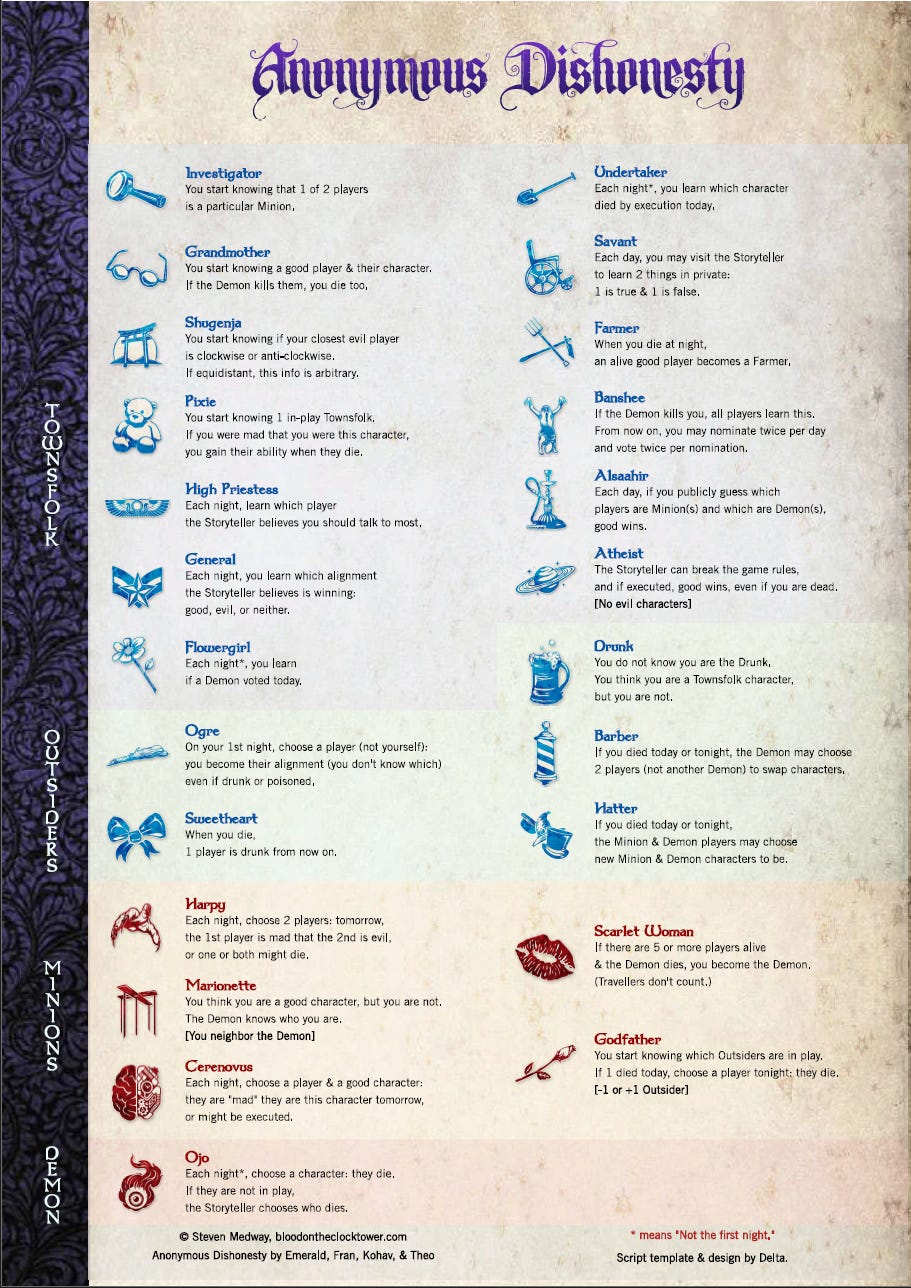
Anonymous Dishonesty is the Carousel script of choice if you want to run Atheist. Midnight Oasis is in that collection too, but this script is often people’s first thought when “Atheist script” is mentioned.
This script environment has all of the good team encouraged to be lying to some extent, making it a script that actually runs opposed to my preferences for Atheist. Executing the Atheist day one is often not the best decision, as they could be the Drunk, and therefore cause an extra kill at night (and the ST/Ojo can simulate this happening). The Atheist may also be a good player who is Cerenovus mad.
Anonymous Dishonesty works as the information derived on the script tends to limit worlds quite heavily, but never conclusively. Most information is “this set of players can be evil” or “these set of things could be true” or “this player is good”. Characters like the High Priestess, General, and Alsaahir don’t create worlds but rather close them or provide direction to the team. The most concrete information on the whole script is the Undertaker, Flowergirl and Savant.
This is great for someone new to running Atheist, who may not yet have the confidence to build out an entire plausible world then break it. You can give information that points nowhere and good will figure it out, but not right away!! Just be careful about Undertaker, Flowergirl, and Savant. You’ll probably still want to pick out a specific evil team frame for these characters at the very least.
When choosing who to kill at night, you have more freedom than you’d expect. Choosing to kill 3 Farmers should be a heavy handed hint: but this is an Ojo only script! A real Ojo could be doing this to back up their minion’s Atheist bluff! That being said, don’t actually kill 3 Farmers unless you think that the player you’re framing would do that, or the group as a whole would think anyone would. One thing that you should be doing when running Atheist is killing the trusted players in the night - as any demon would - but on Anonymous Dishonesty, doing this actually doesn’t make sense from a demon perspective. The Ojo will struggle to kill trusted players if they were not open with what they were, and might kill a frame instead. So the Ojo being perfect is very odd… Which is fine! It’s one of those small breadcrumbs players will largely not notice but realise when the game result is being revealed. It’s better to kill who is healthiest for the game.
The script is quite light on misinformation. Most comes from madness, the Ogre, and the Drunk/Sweetheart. Good lying in order to throw off the Ojo also helps greatly. This means when bag building, you should be careful of what information the good team has available to them, and build bags with failsafes (Scarlet Woman, Barber) or misinformation sources (Sweetheart, Drunk, Cerenovus, Harpy) depending on what you have given to the good team.
Midnight Oasis
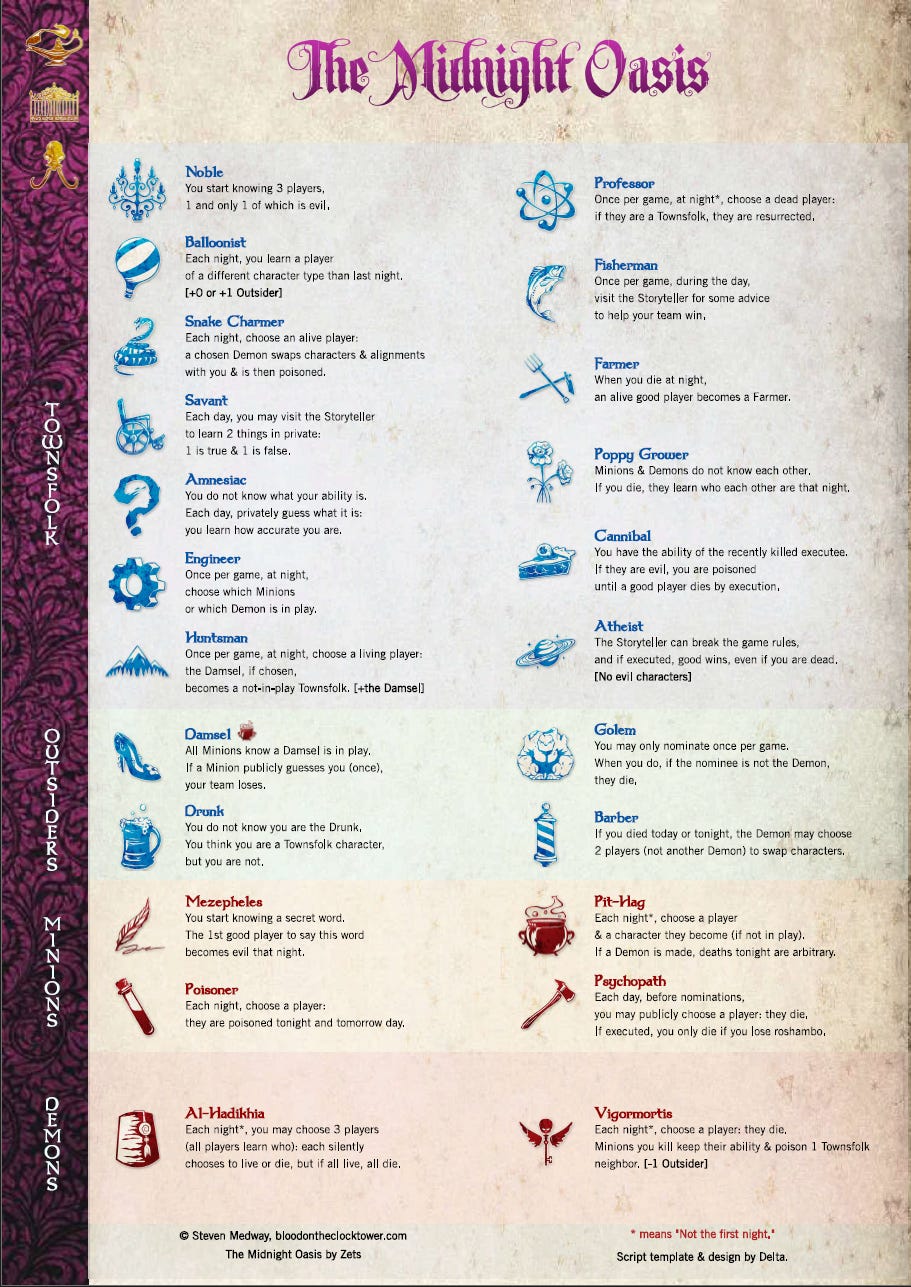
The other Atheist Carousel script is a classic that most know. This is one of the more challenging Atheists to run well, but it’s a lot of fun if you can pull it off.
The script at first glance feels very weird to suggest Puzzle Atheist for, but I’ve run it a few times and it’s always been great fun. I’ve had a few players in my local group who were previously burnt by Shenanigans Atheist really enjoy my Atheist games on this script. Despite the absurdist environment, they felt like I had run a broadly real game of clocktower that they had to figure out!
Midnight Oasis is about raw power: an overpowered good team faces down an overpowered evil team. This overpowered good team is also very good at overpowering the storyteller! Engineers can make simulating a game tougher on you, Snake Charmers can narrow worlds immensely, and Savant has an insane amount of information for good to scrutinise. This script has a great deal of lying, but not as much as Anonymous Dishonesty. Instead, good is using their abilities to figure out what is going on, or actively subvert Atheist games!
The Cannibal & Professor can cause 2 townsfolk to get resurrected, including the Snake Charmer who can then become the Demon and win!
The Engineer can make the ideal evil team (if any exists!).
The Drunk means that the Atheist has a good reason to not claim immediately, as they might catch a Psychopath swinging, not aware that they exist!
The Pit Hag on script also means that evil can do some truly incomprehensible horrors in this environment, such as making yourself into the evil Atheist, 2 loophole evil demons, and turning the mez turned player into an extra minion entirely.
It’s hard to make overarching points on why the script comes together and works, because it really just is raw power. Nothing is nicely combined together in elegant ways, it just rocks solo. That’s kind of why it works.
That being said, when bag building for Midnight Oasis, take into note that this script has a Sentinel. The Sentinel here should be used infrequently, and less so as more outsiders are in the bag by default. You can use it regularly to add outsiders at base 0, but adding more at base 2 can be rough on good. 2 of them are already hidden outsiders, and the Sentinel here is about allowing evil to bluff Outsider at these lower counts.
I have loved this script far before the game I’ll talk about, but this is my Atheist centric essay so I’ll be self-indulgent and talk about my favourite Atheist experience here.
I once ran an Atheist game of this script for an in person group I just joined. I have no idea why they trusted me to run an Atheist script, but they did. When trying to decide what to break, I chose to not put a Damsel into the bag with the Huntsman. Everything else I ran as well as normally as I could. This is an 8 player game, so there should be at most 2 outsiders. I put the Barber & “”””Drunk”””” into the set up.
Initially I was framing the Huntsman as the Poisoner, and the Cannibal as the Vigormortis. I framed the Atheist as the Drunk.
The good team had plenty of tools to figure things out, and some players got very cunning. The Noble learned the Huntsman, the Snake Charmer, and the Atheist. The Engineer heard this Atheist claim, and realised I’d really struggle to frame a real game if they make a Psychopath. It was an amazing plan, and when they did it in the night, I put them to sleep, and quietly mouthed “damn they got me” to someone watching. …Then the Snake Charmer jokingly claims Psychopath the following day and chooses the Huntsman. I have been saved, at the cost of a pivot. The Snake Charmer was now our Psychopath frame, much to his confused glee.
When I next wake him for his choices, I give him a “whatcha gonna do” type shrug and he does it back as he randomly points at some player and I don’t even bother checking if they’re dead.
This actually became the winning decision for the good team. The psychopath swing made all good players think he was evil and the Atheist was drunk, but the Snake Charmer realised they should Damsel guess! If they do this, then the Damsel should be able to come out in every world. He did this, and it immediately sank every world I was framing. The Huntsman had no Damsel, and was confirmed good by being killed by the Psychopath. This was a photo finish as well: the good team was just discussing who’s the most likely Demon on the 2nd call of the final day before they realised the Huntsman was missing a damsel.
I think this is a good example of a Puzzle Atheist game on Midnight Oasis. The game became mechanically solved because good players used their abilities wisely and forced me to make pivots that helped solve Atheist for them, despite the lack of information on the script!
I hope this story is a good example of the kind of Atheist environment this is. Simulating a real game is tough work, and good will make it harder on you!
Star’s Edge
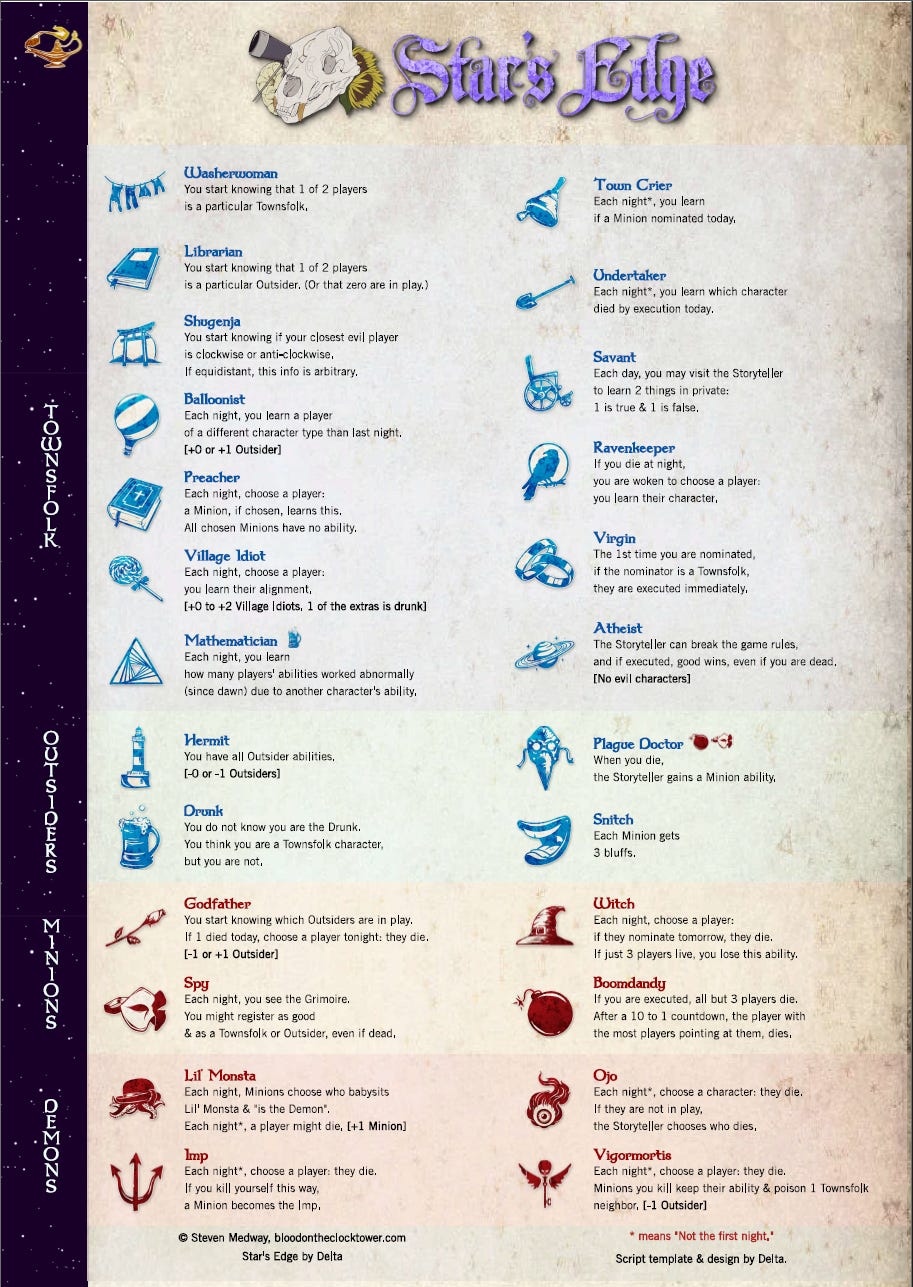
Full disclosure: this is my own. This script has become a favourite of mine to run in my local group, though, as it has exactly what I want from the Atheist. It has also appeared on The Pandemonium Institute, run by Edd! It was the first script used in Edd’s recent decision to show off Puzzle Atheist more on stream. It was an Atheist game where good lost, which is a rarity in streaming and made for a very interesting game to watch.
This was when the script had an organ grinder, and good voted 4 on Edd and 4 on a player. It was VERY close, but the tie used a lot of ghost votes from players who believed it was Atheist. Watching this & some feedback from a player in this game was why Organ Grinder left the script, mostly because watching other players vote is very important to Atheist games.
The environment encourages the good team to be mostly open about what they are. With an Ojo & Spy, it’s very unlikely that hiding is effective, so (with few exceptions), players tend to just be open about what they are and know. Snitch is here to help evil players fit into this kind of environment, and with the Hermit interaction provides an alternative explanation for why all players had a bluff ready to go within Atheist games.
The script is focused around the Hermit-Drunk-Plague Doctor and the jinx with the Boomdandy. Executing the Atheist day one becomes extremely risky due to it, but it is recommended that the Hermit exploding should only happen with the Hermit-Atheist. (The new jinx still works with this, if you fudge the timing a bit, according to Jams!!! The script lives!!!) All misinformation comes from the Drunk ability, and a bit more from the Spy. This leads to a script environment where identifying what misinformation exists and why leads you to the Drunk, Hermit, or an evil player!
With the script environment so open, it allows for the most collaboration and disagreement over the gamestate and who to execute. The worlds on this script resolve as being probabilistic: you can build worlds where anyone is good or anyone is evil. Later in the game, you’ll find that it tends to close down, where the worlds slowly become logically solvable due to the closed possibilities, increased information amount, and a game of socials to dig through.
The low nonsense environment allows Puzzle Atheist to truly shine through: games of Star’s Edge become a large town wide debate over what is happening. In the last game I ran of Star’s Edge, many players did not leave their seats to privately chat on day 3: they were too invested in the ongoing town discussion and adding to it!
The Vigormortis in base 0 & base 1 guarantees there are no Drunks, but makes up for it by being able to slowly poison the good team by killing their minions. The Imp & Lil Monsta have superb mobility, making killing Minions something good should do, but Boomdandy can make this difficult for good to achieve. The Ojo might feel odd here, but it can take out key threats if good chooses to hide without needing to talk to a Spy, and a miss can simulate a Godfather kill: allowing the Ojo to frame any player as a Hermit or Drunk. The Mathematician here uses the jinx strictly, so you should read the jinx as if it has no “might”.
When bag building for Star’s Edge, 100% use the -1 from the Hermit ability often. It is strong here, and is only tempered by removing other outsiders from the game or the Librarian seeing them. You can choose not to do this if it’d end up removing the Hermit or you feel like good has a strong town and evil needs the help. Remember that with Vigormortis at base 0 with Godfather, you can still get an outsider from that! Rarely add an Outsider with the Balloonist unless both will be face up.
Conclusion
For a long time, I’ve disliked the Atheist. The character seemed silly. Vacuous. Empty.
But when I first ran an Atheist game where I seriously tried to frame a real game with an engaging puzzle, I found the joy in this character. Watching players slowly work it out, trusting each other almost enough to believe the Atheist for most of the game before coming to the correct solution made the character come to life.
When I showed restraint, the Atheist showed what it was: something truly special.
I’m not the most experienced atheist storyteller, but some of those games are some of my players’ favourite games ever. I’ve spent a long time thinking about this character, and for many of my veteran players, I am the first storyteller they can trust to run an interesting and meaningful Atheist game.
The Atheist is sincerely one of the most interesting characters in this game, and I hope I’ve convinced you that it can be so much more than just shenanigans. I hope to see more Puzzle Atheist because this character shows off the elegance of Clocktower as a game. Atheist takes a jokey, prank concept that predates Clocktower (“what if there are no werewolves?”), and transforms it into a whole other dimension of the game. Atheist scripts play upon your social deduction skills to work out if evils exist, twisting and reinventing Clocktower from the ground up. Despite that inversion, Clocktower remains at its core, a game about finding trust in each other. In an Atheist game, it’s a cooperative experience where distrust might get in the way: and where trust guides you to victory.
The Atheist is cool.
Credits
Huge credit to Amy (@cakeandlies on Discord) who did, quite frankly, an academic amount of review over this essay. I’ve not written essays since University, so having her put so much work into helping the structure of the document was invaluable. If you liked a lot of the writing here, credit Amy!
Thank you to Jenna Someya who drew the cool skull you saw at the beginning. She does cool stuff!
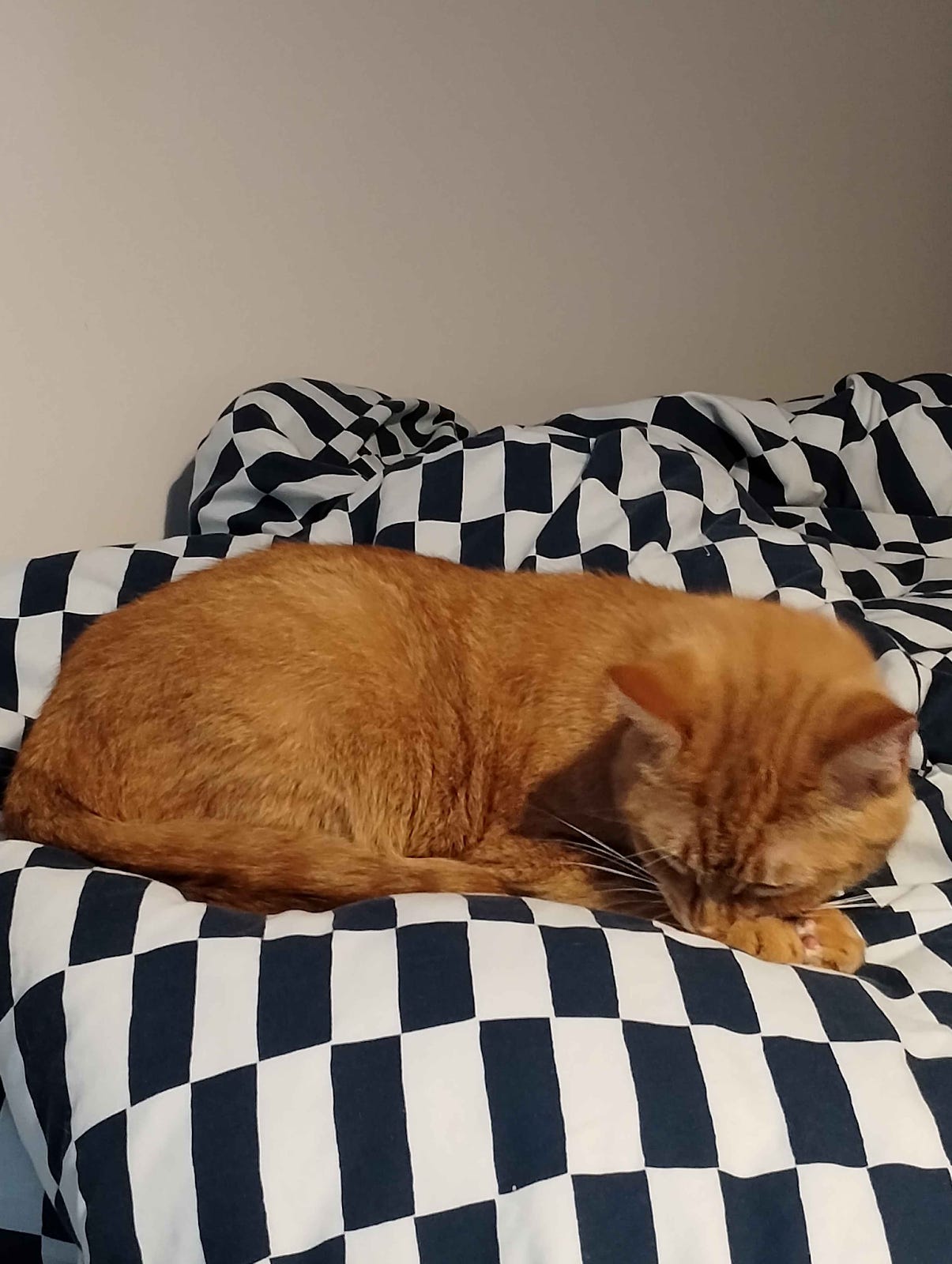
No CREDIT TO CHEESE!!! Bro kept distracting me by lying down on my desk from the mission of this essay. Evil.
Also play Star’s Edge.
Some other links that are useful to read!
https://wiki.bloodontheclocktower.com/Atheist The Atheist almanac
https://bit.ly/AtheistBOTC - Atheist guide written by Steven Medway with edits/additions by Edd.
Emma’s Atheist essay.

https://docs.google.com/spreadsheets/d/1mBXn8JVK4rFRyOBKj2dzbxRyR9XKCpdPhdTL3A13EqA/edit?usp=sharing
Atheist questionnaire results
Scripts Mentioned:
https://www.botcscripts.com/script/104/3.8.0 The Midnight Oasis
https://www.botcscripts.com/script/7649/2.2.0 Star’s Edge
https://www.botcscripts.com/script/3728/1.0.1 Anonymous Dishonesty